

How Much Does a Fractional CMO Cost?
Updated: May 12

Most founders and business leaders don’t begin by asking, “How much does a Fractional CMO cost?” Instead, the question tends to emerge after a period of frustration especially when marketing spend is increasing but results are not, when growth feels inconsistent, or when there is no clear strategic direction guiding the team.
In many cases, the underlying issue is not effort or execution, but a lack of senior marketing leadership. Without that leadership, campaigns become disconnected, budgets are misallocated, and opportunities for growth are missed.
This article provides a clear and practical breakdown of what a U.S.-based fractional CMO costs, what influences that cost, and what businesses should expect in return. More importantly, it reframes the conversation from cost alone to the broader impact on growth, efficiency, revenue, and long-term performance.
What Is a Fractional CMO and Why Do Businesses Hire One?
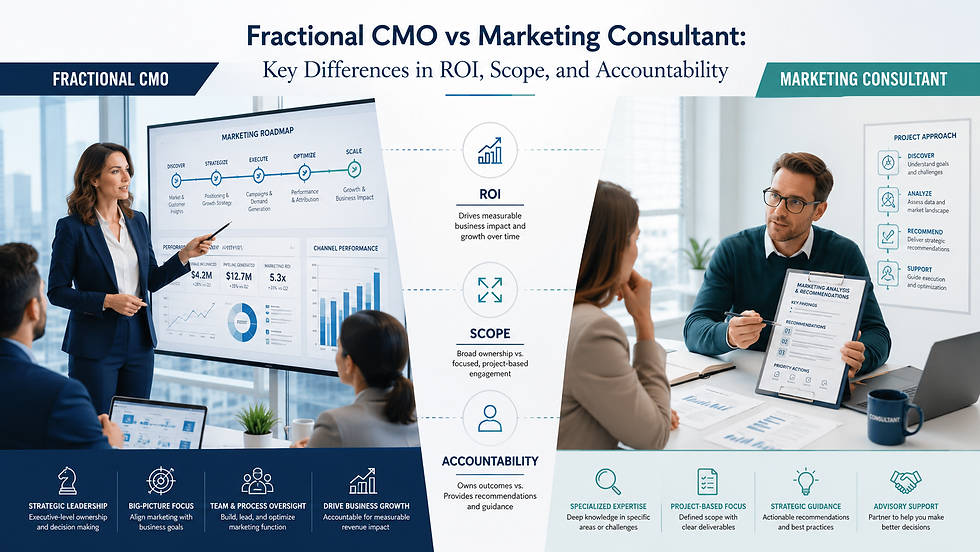
A fractional CMO is an experienced marketing executive who works with a business on a part-time or flexible basis, providing strategic leadership without the financial commitment of a full-time hire. Unlike agencies or freelancers who typically focus on execution, a fractional CMO operates at a leadership level, taking responsibility for direction, planning, and performance.
Businesses tend to engage a fractional CMO when marketing has become complex and lacks cohesion. This often happens when a company is scaling, when internal teams are active but not aligned, or when external agencies are delivering outputs without a unifying strategy. In these situations, the absence of leadership leads to common frustrations such as not knowing which marketing strategy actually works, spending without a clear ROI, or feeling uncertain about customer targeting.
Fractional CMO Cost?

The cost of a fractional CMO varies depending on the level of involvement, the complexity of the business, and the scope of work required, but there are consistent ranges that provide a useful benchmark.
Ongoing Engagement (Monthly Retainer)
Most businesses invest between $4,000 and $15,000+ per month for ongoing engagements. At the lower end of this range, the engagement is typically more advisory in nature, with limited hours focused on high-level guidance. At the higher end, the Fractional CMO is more deeply embedded in the business, taking an active role in leadership, team management, and ongoing strategic execution.
Hourly Engagement
Hourly rates generally range from $150 to $400+ per hour, although this model is more commonly used for short-term advisory support rather than sustained engagement where monthly retainers are the norm. While hourly arrangements can be useful for specific challenges, they often lack the continuity required to drive meaningful growth over time.
Project-Based Engagement
For project-based work, such as developing a go-to-market strategy, conducting a marketing audit, or building a comprehensive marketing strategy, costs typically range from $5,000 to $30,000+. These engagements are often the starting point for businesses that need clarity before committing to a longer-term partnership.
What Factors Influence the Cost of a Fractional CMO?
While headline pricing ranges are useful, the actual investment required depends on several underlying factors, particularly the stage of the business, the scope of work required, the complexity of the marketing environment, and the level of involvement expected, which ultimately shape both the scope and the impact of the role.
To better understand how these variables influence cost, it’s helpful to look at each factor in more detail.
One of the most significant drivers is the stage of the business. Early-stage companies often require foundational work, such as defining positioning, identifying target customers, identifying and implementing the marketing tech stack, and building an initial strategy and budget. In contrast, more established businesses tend to need optimization, performance improvement, and better alignment across existing channels.
The scope of work also plays a critical role. A business seeking purely strategic input will invest less than one that requires ongoing leadership, team oversight, and hands-on involvement in execution. Similarly, the complexity of the marketing environment such as operating across multiple channels, managing long sales cycles, or targeting diverse customer segments, will increase the level of effort required.
Finally, the level of involvement matters significantly. Some businesses only need periodic guidance, while others require a consistent leadership presence to bring structure, accountability, and momentum to their marketing efforts.
What Do You Actually Get for the Cost?
It’s easy to focus on the cost of a fractional CMO in isolation, but this perspective often overlooks what the role is designed to deliver. At its core, a Fractional CMO provides clarity, direction, and alignment, three elements that are frequently missing in
underperforming marketing functions.
In practice, this translates into a combination of strategic leadership and structured execution, including:
A clear and cohesive marketing strategy aligned with business goals
Defined priorities and roadmap, ensuring teams focus on what drives growth
Smarter budget allocation, reducing wasted spend and improving ROI
Well-defined customer segments and positioning, improving targeting and messaging
Structured campaign planning, with clear objectives and measurable outcomes
Performance tracking and reporting frameworks, enabling data-driven decisions
Beyond strategy, a fractional CMO also plays a critical leadership role across the organization, such as:
Aligning internal teams and external agencies under a unified direction
Establishing accountability and processes to maintain consistency
Providing senior-level decision-making support for marketing investments
Bringing an outside perspective, identifying gaps and opportunities quickly
The result is not just more organized marketing activity, but a system that produces more consistent, predictable, and scalable growth over time.
For example, a B2B service business may be investing $15,000 to $20,000 per month across paid ads, SEO, and content, yet still struggles to identify which channels are actually driving qualified leads. In this situation, a fractional CMO can step in to restructure attribution, reallocate budget toward high-performing channels, and align campaigns with revenue goals, often leading to immediate improvements in lead quality and cost efficiency.
Fractional CMO vs Full-Time CMO: Cost Comparison
When comparing options, it’s important to consider the full cost of hiring a full-time Chief Marketing Officer in the United States, which typically ranges from $250,000 to $400,000+ per year, before factoring in benefits, bonuses, and recruitment costs.
For many small to mid-sized businesses, this level of investment is difficult to justify, particularly if the organization does not yet require full-time executive capacity. A fractional CMO offers a more flexible alternative, allowing businesses to access senior expertise in proportion to their needs while avoiding the financial risk associated with a permanent hire.
This model is not about replacing a full-time CMO, but about accessing the same level of strategic capability in a way that aligns with the current stage and priorities of the business.
Is Hiring a Fractional CMO Worth the Investment?
For businesses experiencing inconsistent growth or unclear marketing performance, the more relevant question is not whether a fractional CMO is expensive, but whether the current approach is effective.
When marketing lacks direction, it often leads to wasted spend, fragmented campaigns, and missed opportunities. Over time, these inefficiencies can cost significantly more than the investment required to introduce strategic leadership.
A fractional CMO addresses these challenges by bringing structure, accountability, and a clear framework for measuring ROI and decision-making. This enables businesses to move away from reactive marketing and toward a more deliberate, outcome-focused approach.
When Should You Hire a Fractional CMO?
There are clear indicators that suggest a business would benefit from this type of engagement, and these signals often become more obvious as marketing efforts begin to scale but results remain inconsistent.
Common signs include:
Growth has plateaued despite ongoing marketing activity and spend
Teams are busy but outcomes are inconsistent, with no clear pattern of success
No senior marketing leader is responsible for overall strategy and performance
Marketing decisions feel reactive, rather than guided by a clear plan
It is also common for businesses to reach a point where they are investing across multiple channels or working with several agencies, yet still lack a unifying direction. In these situations, the problem is not a lack of activity, but a lack of coordination and leadership.
In these cases, a fractional CMO provides the structure, oversight, and strategic clarity needed to bring everything together into a more focused and effective growth system.
However, it’s worth noting that very early-stage businesses without product-market fit or sufficient budget may not yet be in a position to fully benefit from this level of support.
How to Choose the Right Fractional CMO Engagement Model
The most effective engagement model depends on the specific needs of the business, as well as the level of involvement required to achieve meaningful outcomes. Some organizations benefit from ongoing monthly support that provides continuity and oversight, while others require a more embedded, part-time leadership presence that integrates closely with internal teams.
In certain situations, such as periods of transition or rapid change, an interim engagement may be the most appropriate approach, offering immediate expertise without long-term commitment. For businesses operating with distributed teams or seeking greater flexibility, a virtual model can deliver the same level of strategic input without geographic constraints. Alternatively, some companies choose to fully outsource their marketing leadership function, particularly when they lack internal resources or do not wish to build an in-house team.
At Growth Marketing Partner, businesses can engage a Fractional CMO on a part-time, interim, virtual, or fully outsourced basis, allowing the structure of the engagement to align with both their current challenges and future growth plans. This flexibility ensures that companies are not over-investing in capacity they do not need, while still gaining access to the leadership required to move forward with confidence.
Final Thoughts: Cost vs. Value in Strategic Marketing Leadership
Ultimately, focusing solely on cost can be misleading if it is not considered in the context of value. The more important question for most businesses is what ineffective or unstructured marketing is currently costing them in lost opportunities, wasted budget, and stalled growth.
Strategic marketing leadership provides the foundation for more efficient decision-making, better alignment across teams, and a clearer path to scalable growth. In that sense, a Fractional CMO is not simply an expense, but an investment in building a more predictable and sustainable growth engine.
If you are looking to bring clarity, structure, and measurable growth to your marketing, consider booking a free consultation with Growth Marketing Partner to explore how a fractional CMO can support your business.


Comments