

Fractional CMO vs Marketing Consultant: Key Differences in ROI, Scope, and Accountability
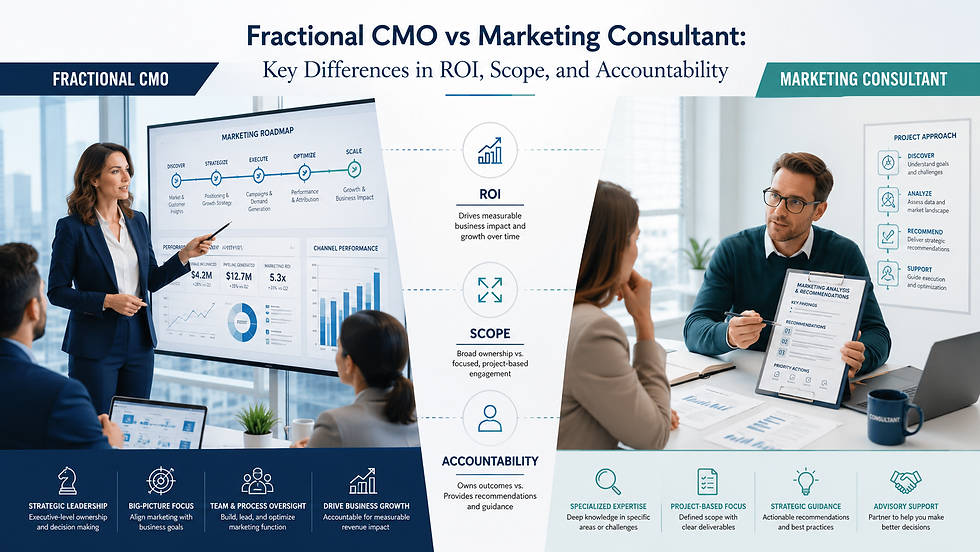
When your company needs stronger marketing direction, it can be difficult to know whether to hire a fractional CMO or a marketing consultant. Both can bring valuable senior-level expertise. But they do not solve the same problem.
A fractional CMO typically provides ongoing executive marketing leadership. They help set strategy, guide planning, manage priorities, align teams and vendors, and create accountability around marketing performance. A marketing consultant usually provides expert advice on a specific problem, project, channel, or strategic question.
The better choice depends on your company’s current constraint. If you need leadership, structure, budget discipline, and ongoing accountability, a fractional CMO is usually the stronger fit. If you need targeted expertise on a defined issue, a marketing consultant may deliver better ROI.
For founders, CEOs, and business owners, the real question is not simply, “Which one costs less?” It is, “Which one will help us make better marketing decisions, use our budget more effectively, and create measurable progress?”
This guide breaks down the key differences in scope, ROI, and accountability so you can make a more informed decision based on your business needs.
What Is the Difference Between a Fractional CMO and a Marketing Consultant?
A fractional CMO acts as an ongoing senior marketing leader. A marketing consultant typically advises on a specific challenge, project, or area of expertise.
The simplest distinction is this:
A fractional CMO provides marketing leadership. A marketing consultant provides marketing advice.
That does not mean one is better in every situation. It means they serve different business needs.
A fractional CMO often operates as part of the leadership team and is embedded within the organization. They help connect marketing decisions to company goals, revenue targets, budget realities, sales priorities, and growth plans. Their role is usually broader than one campaign, one channel, or one deliverable.
A marketing consultant, by contrast, is often brought in to solve a defined problem. That might include reviewing a paid media strategy, improving messaging, auditing SEO, refining positioning, conducting market research, or advising on a campaign plan.
Here is a simple comparison:
Category | Fractional CMO | Marketing Consultant |
Primary Role | Ongoing executive marketing leader | Advisor or specialist |
Core Value | Strategic leadership and accountability | Targeted expertise |
Typical Scope | Broad marketing strategy, planning, budget, team and performance management | Specific project, issue, channel, or deliverable |
Best For | Companies without senior marketing leadership | Companies with a defined marketing challenge |
Accountability | Often tied to business goals and marketing performance | Usually tied to recommendations or project deliverables |
Time Horizon | Ongoing or retained engagement | Short-term, project-based, or advisory |
Decision Involvement | Helps guide leadership decisions | Advises but may not own decisions |
The difference matters because many companies misdiagnose their marketing problem. They assume they need another campaign, another channel, or another consultant when what they really need is strategic ownership.
What Does a Fractional CMO Do?
A fractional CMO provides part-time or retained executive marketing leadership for companies that need senior strategy without hiring a full-time Chief Marketing Officer.
This role is especially valuable for startups, scaleups, and early-to-mid-stage companies that have outgrown founder-led marketing but are not ready for a full-time CMO.
A fractional CMO may support:
Annual marketing planning
Marketing budget development
Forecasting and performance goals
Buyer personas
Brand positioning
Team and vendor alignment
Agency oversight
Marketing reporting
Sales and marketing alignment
Executive decision support
The value of a fractional CMO is not only in creating a strategy. It is in helping the company establish a foundation and process to make better marketing decisions over time.
For example, a startup may be investing in SEO, paid media, content, events, and agencies, but may feel unclear about what is actually driving growth. The founder may be approving campaigns reactively. The sales team may be asking for more or better leads. The marketing team may be busy, but not aligned around a clear plan or outcomes.
A fractional CMO can step in to clarify the company’s target segments, define priorities, align the marketing budget to business goals, establish performance reporting, and help the team focus on the activities most likely to support growth.
This is where strategic accountability becomes important. A fractional CMO is not just asking, “What marketing activity should happen?” They are asking:
What are we trying to achieve?
Which customers are we trying to reach?
Which marketing investments matter most right now?
How should we allocate budget?
What should we stop doing?
How will we measure progress?
Who is accountable for execution?
How do we better support the sales team?
For companies that need structure, focus, and leadership, those questions can have a significant impact on ROI.
What Does a Marketing Consultant Do?
A marketing consultant provides specialized expertise to help solve a specific marketing problem, improve a channel, validate a strategy, or complete a defined project.
A consultant can be highly valuable when the company already knows what problem it needs to solve. For example, a business may need an outside expert to review its website conversion path, improve messaging, conduct customer research, assess paid media performance, or create a launch plan.
Common marketing consultant engagements include:
Brand positioning audits
SEO strategy
Paid media reviews
Website conversion analysis
Messaging refinement
Campaign planning
Sales enablement support
CRM or marketing operations recommendations
Customer journey mapping
A consultant may create excellent recommendations. But in many cases, they are not responsible for leading the broader marketing function, managing tradeoffs, aligning vendors, owning the marketing budget, managing the team or agencies, or ensuring that execution stays connected to business goals over time.
That is not a weakness. It is simply a different model.
A marketing consultant is often the right fit when the business has a clear internal owner who can take recommendations and move them forward. For example, if a company already has a marketing director but needs expert input on SEO, messaging, or lead generation, a consultant can provide focused support without taking on a broader leadership role.
The risk comes when a company hires a consultant for a project when the real problem is lack of leadership or cohesive marketing strategy. In that case, the consultant may deliver a useful strategy, audit, or recommendation, but no one inside the company has the time, authority, or experience to prioritize and implement it.
That is when consulting work can become another document instead of a driver of growth.
Fractional CMO vs Marketing Consultant: Scope, ROI, and Accountability Compared
A fractional CMO usually has a broader scope and greater accountability for marketing performance. A marketing consultant usually has a narrower scope and delivers ROI by solving a specific problem efficiently.
The right choice depends on what your company actually needs.
Decision Factor | Fractional CMO | Marketing Consultant |
Strategic Ownership | High | Moderate to limited |
Execution Oversight | Often involved | Sometimes, depending on engagement |
Budget Guidance | Usually included | May be limited to a project area |
Team Leadership | Often included | Usually not included |
Vendor Management | Often included | Sometimes included |
Revenue Alignment | Strong focus | Depends on project |
Best ROI Scenario | Company lacks senior marketing leadership | Company has a defined problem |
Accountability | Ongoing performance and strategic alignment | Project deliverables and recommendations |
Cost Structure | Retainer or part-time executive engagement | Hourly, project-based, or advisory fee |
Ideal Company Stage | Startup, scaleup, or early-to-mid-stage company | Any company with a specific need |
Typical Output | Strategy, plan, budget, priorities, team alignment, reporting | Audit, recommendations, project plan, research, or specialized guidance |
Scope matters because marketing ROI rarely comes from isolated activity alone. It comes from the connection between strategy, audience, budget, execution, measurement, and decision-making.
A consultant might improve one piece of the marketing system. A fractional CMO is more likely to evaluate the system as a whole.
For example, a consultant may identify that paid media campaigns are underperforming because the landing pages are weak. A fractional CMO may look more broadly and ask whether the company is targeting the right segment, using the right offer, allocating budget appropriately, following up with leads effectively, and measuring results in a way that supports executive decisions.
Both perspectives can be useful. But they solve different levels of the problem.
As marketing complexity increases, accountability becomes more important. A company with one marketing channel and a small budget may only need project-based advice. A company with multiple campaigns, vendors, customer segments, sales goals, and budget decisions may need someone to own the broader marketing direction.
That is often where a fractional CMO delivers stronger value.
Which Option Delivers Better ROI?
Neither a fractional CMO nor a marketing consultant automatically delivers better ROI. The better ROI comes from matching the role to the company’s actual need.
A fractional CMO tends to deliver better ROI when the business lacks senior marketing leadership. A marketing consultant tends to deliver better ROI when the company has a specific, well-defined problem and the internal team can execute the recommendations.
ROI depends on several factors:
Business stage
Internal team capability
Clarity of marketing goals
Budget size and allocation
Sales and marketing alignment
Quality of execution
Decision-making speed
Data visibility
Whether someone owns the full marketing system
A fractional CMO may create ROI by helping the company avoid wasted spend, focus on better-fit customers, prioritize the right channels, improve forecasting, and align marketing activity with revenue goals.
A consultant may create ROI by solving a specific issue quickly and efficiently.
Example: When a Fractional CMO May Deliver Better ROI
A B2B company is spending across SEO, paid media, webinars, events, and agency retainers. The team is busy, but leadership cannot clearly see which efforts are contributing to pipeline or revenue. The founder is still making many marketing decisions, but does not have time to manage the full function.
In this case, the company may not need another campaign idea. It needs marketing leadership.
A fractional CMO can help build an annual marketing plan, evaluate the budget, define KPIs, improve segmentation, align campaigns to sales goals, and create a clearer reporting structure. The ROI comes from better decisions, reduced waste, and more accountable execution.
Example: When a Marketing Consultant May Deliver Better ROI
A professional services firm already has a strong internal marketing leader, a clear plan, and a defined budget. However, the company needs help refining its website messaging to better speak to a specific buyer segment.
In this case, a consultant with messaging or conversion expertise may be the more efficient choice. The problem is clear. The deliverable is defined. The internal team can implement the recommendations.
The ROI comes from targeted improvement without adding unnecessary leadership scope.
The key is to avoid choosing based on title alone. The right question is:
What is the business constraint: lack of expertise on a specific issue, or lack of senior marketing leadership or overall marketing strategy?
When Should You Choose a Fractional CMO?
Choose a fractional CMO when your company needs senior marketing leadership, not just recommendations.
A fractional CMO is often the better fit when marketing activity is happening, but direction, prioritization, and accountability are unclear.
You may need a fractional CMO if:
Marketing feels scattered or reactive
The company does not have a clear marketing strategy
The founder or CEO is still making too many marketing decisions
The marketing budget lacks structure
Forecasting is unclear
Campaigns are active, but ROI is hard to evaluate
The company has agencies or freelancers but no senior marketing owner
Sales and marketing are misaligned
The team lacks clear customer segmentation or buyer personas
The company is preparing for growth, funding, expansion, or a new go-to-market push
Marketing decisions are being made without enough executive-level guidance
The business needs senior marketing support but is not ready to hire a full-time CMO
A fractional CMO can be especially valuable for companies moving from early traction to more structured growth. At that stage, the marketing needs often become more complex. The company may need better planning, stronger reporting, more disciplined budget allocation, clearer positioning, and tighter alignment between marketing and sales.
In other words, the business does not just need more marketing activity. It needs a marketing operating system.
This is where Growth Marketing Partner supports founders, CEOs, and leadership teams. Led by Alexandra Chrisman, Growth Marketing Partner helps companies bring senior-level marketing thinking into the business without the cost or commitment of a full-time executive hire.
When Should You Choose a Marketing Consultant?
Choose a marketing consultant when you have a specific problem, project, or area of expertise you need help with.
A consultant may be the better fit if:
The company already has marketing leadership
The problem is narrow and clearly defined
The engagement has a specific deliverable
The internal team can execute recommendations
The company needs outside perspective on one area
The business does not need ongoing leadership or accountability
The budget is focused on a specific project rather than broad marketing leadership
For example, a real estate company may have a marketing leader in place but need help improving lead capture on its website. A financial services firm may need a consultant to review compliance-sensitive messaging. A B2B company may need an expert to audit paid media performance or refine a content strategy.
In each of these cases, a consultant can provide focused expertise without taking over the broader marketing function.
The consultant model works best when there is already someone inside the company who can make decisions, manage priorities, and ensure follow-through.
Without that internal owner, even strong consulting recommendations can stall.
Common Mistakes Companies Make When Choosing Marketing Support
The biggest mistake companies make is hiring for the symptom instead of the underlying problem.
If marketing performance is weak, the cause may not be the campaign, agency, website, or channel. It may be the absence of clear strategy, prioritization, budget discipline, and leadership accountability.
Here are several common mistakes to avoid.
1. Hiring a Consultant When the Real Need Is Leadership
A consultant can provide excellent recommendations. But if no one owns the marketing plan, budget, team alignment, or execution priorities, recommendations may not turn into results.
If your company keeps hiring specialists but still lacks direction, the issue may be leadership.
2. Hiring a Fractional CMO for a Narrow Tactical Project
A fractional CMO is not always necessary. If the company only needs an SEO audit, a messaging workshop, or a paid media review, a consultant may be more appropriate.
Using a Fractional CMO for a narrow project can create unnecessary scope and cost.
3. Expecting Strategy Without Sharing Business Context
Marketing strategy requires access to business goals, revenue targets, customer insights, budget constraints, sales performance, and leadership priorities.
If a company withholds context, both fractional CMOs and consultants will be limited in the quality of guidance they can provide.
4. Measuring ROI Too Early or Too Narrowly
Some marketing improvements take time to show measurable results. Strategic work such as positioning, segmentation, planning, and budget realignment may not immediately appear as short-term lead volume, but it can improve decision-making and performance over time.
ROI should be evaluated based on the purpose of the engagement.
5. Confusing Activity With Progress
More campaigns do not always mean better marketing. More vendors do not always mean better execution. More reports do not always mean better decisions.
Strong marketing leadership helps determine which activities matter most and which ones should stop.
6. Hiring Multiple Vendors Without a Senior Marketing Owner
Agencies, freelancers, and consultants can all add value. But without a senior marketing leader coordinating them, execution can become fragmented.
A fractional CMO can help ensure that outside partners are aligned to the same strategy, priorities, budget, and performance expectations.
Can You Use Both a Fractional CMO and Marketing Consultants?
Yes. In many companies, a fractional CMO and marketing consultants can work well together.
The fractional CMO can own the strategy, planning, prioritization, and accountability framework. Consultants can support specialized projects within that broader plan.
For example, a fractional CMO may develop the annual marketing plan, define customer segments, create a budget framework, and establish KPIs. Then, a consultant may be brought in to support a website conversion audit, SEO strategy, paid media review, or messaging project.
In this model:
The fractional CMO provides strategic direction
Consultants provide specialized expertise
Agencies and freelancers support execution
Internal teams stay aligned around clear priorities
This structure can reduce wasted effort because specialists are not working in isolation. Their work supports a larger marketing strategy.
For growing companies, this can be a strong model. It gives the business senior-level marketing leadership while still allowing access to deep expertise when needed.
How Growth Marketing Partner Helps Companies Build Strategic Marketing Leadership
Growth Marketing Partner helps startups, scaleups, and early-to-mid-stage companies gain senior-level marketing leadership without the full-time CMO cost.
We support companies that need clearer strategy, stronger planning, and more accountable marketing execution. The work is especially relevant for founders, CEOs, business owners, and marketing decision-makers who are trying to move from scattered marketing activity to structured growth.
Growth Marketing Partner can help with:
Annual marketing planning
Marketing budgeting
Forecasting
Buyer personas
Sales and marketing alignment
Marketing team and vendor coordination
Executive-level marketing guidance
The goal is not to add more activity for the sake of activity. The goal is to help leadership teams make better marketing decisions, use resources more effectively, and build a clearer path toward growth.
For many companies, the biggest marketing opportunity is not simply doing more. It is doing the right things in the right order, with the right accountability.
FAQs About Fractional CMOs and Marketing Consultants
What is the main difference between a fractional CMO and a marketing consultant?
The main difference is scope and accountability. A fractional CMO provides ongoing executive marketing leadership, while a marketing consultant usually advises on a specific problem, project, or area of expertise.
Is a fractional CMO more expensive than a marketing consultant?
Often, yes, on a monthly basis. A fractional CMO usually has a broader role that may include strategy, planning, budget guidance, team alignment, vendor oversight, and performance accountability. A consultant may cost less for a defined project, but the value depends on whether the engagement solves the right problem.
Which delivers better ROI: a fractional CMO or a marketing consultant?
A fractional CMO may deliver better ROI when the company needs senior marketing leadership and ongoing accountability. A marketing consultant may deliver better ROI when the company has a specific, well-defined challenge and an internal team that can execute the recommendations.
When should a startup hire a fractional CMO?
A startup should consider hiring a Fractional CMO when the founder is still leading marketing decisions, campaigns feel scattered, the budget lacks structure, or the company needs a clearer growth strategy before hiring a full-time CMO.
When is a marketing consultant the better choice?
A marketing consultant is often the better choice when the company has a narrow problem to solve, such as improving messaging, auditing SEO, reviewing paid media, or developing a campaign plan. The consultant model works best when internal leadership already exists.
Can a company use both a fractional CMO and marketing consultants?
Yes. A fractional CMO can lead the overall strategy and accountability framework, while consultants provide specialized expertise for specific projects. This can help companies get both strategic leadership and targeted support.
Conclusion: Which One Should You Choose?
A marketing consultant is often the right choice when you need expert help with a defined project or specialized challenge. A fractional CMO is usually the better fit when your company needs senior marketing leadership, strategic accountability, budget guidance, and ongoing growth direction.
The decision should come down to your company’s real constraint.
If you already have strong marketing leadership and need help with one specific issue, a consultant may be the most efficient choice. If marketing feels scattered, reactive, or disconnected from business goals, a Fractional CMO may create stronger ROI by bringing structure, focus, and accountability.
Growth Marketing Partner helps companies clarify that decision and build a more strategic approach to marketing leadership, planning, budgeting, forecasting, segmentation, and growth execution.
Need senior marketing guidance without hiring full-time? Book a free consultation with Growth Marketing Partner to clarify your next best marketing move.



Comments